
Strategy
Beyond the Double Diamond.
Generative AI has compressed the product lifecycle, requiring we adopt fundamentally new approaches to problem-solving, collaboration, and testing.

Overview
For over 20 years, The Double Diamond has guided product teams towards designing the right things, and designing those things right. Its strength being in the way it balanced divergent thinking (what problems to solve) and convergent thinking (how to solve them).
But with AI now compressing the time both take to perform — analysing data at scale, quickly generating solutions — a linear model starts to feel obsolete. It’s forcing us to reshape our approach to problem-solving.
For those reasons, I’ve adopted The Stingray Model as my preferred framework due to the way it delivers speed, scale, and non-linear problem-solving.
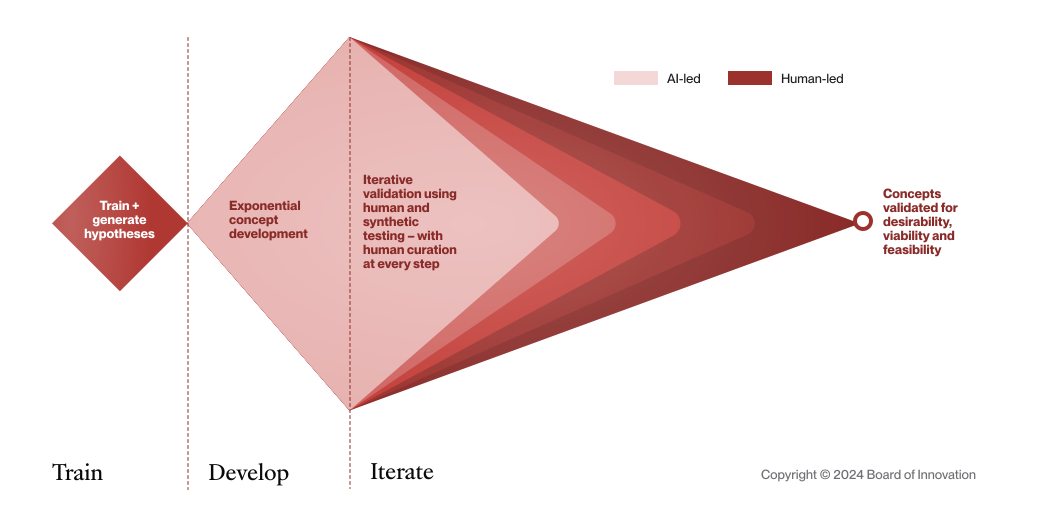
01. Train
Establish strong foundations to build upon
Defining clear goals and gathering the customer, market, and business intelligence the process will rely on.
02. Develop
Simultaneously explore problems and solutions
Generating hypotheses and solutions simultaneously, enabling the exploration of multiple directions instead of a handful.
03. Iterate
Validate concepts through continuous refinement
Cycling concepts through synthetic and human testing, pressure-tested against desirability, feasibility, and viability at once.
My Deck of AI Agents
I use custom AI agents to accelerate different phases of my workflow.
Instead of performing every task myself, I act as the orchestrator, guiding autonomous AI systems to handle user research, ideation, and prototyping.
01 / 07
The Meticulous Critic
Provides structured feedback on a design.
Takes a screenshot or Figma file and returns a structured critique: strengths called out alongside problems, each framed by user impact, with specific changes to try and examples or data behind every call. Most effective during early review, when feedback is still cheap to act on.